
The Real AI Prize Is Not the Tool

Five stories. Five different contexts. One pattern that would not go away.
A hospital that attempted to vibe-code an enterprise revenue cycle system, not because the technology failed, but because no one asked whether that was the right category of problem for that category of tool. A proven platform that could not be commercialized at scale because the governance structure changed around it. European partnerships that became possible only after learning to extend trust before it was earned, a cross-cultural operating lesson disguised as a technology problem. A platform vision rejected not because it was wrong, but because the organization was not yet structured to act on it. A technology choice resisted on career anxiety rather than merit, proven right only when use cases replaced tools as the filter.
In each case, the technology was not the constraint. The constraint was governance, operating model, institutional readiness, or the mental model of the executive making the call.
That is not a coincidence. It is the finding.
I did not set out to write a series about institutional behavior. I set out to write about decisions I had made and what I had learned from them. But when I reviewed the five pieces together, the same friction appeared in each one, wearing different clothes.
The friction is not between new technology and old technology. It is between what a system can generate and what an institution can absorb. Those are not the same thing, and the gap between them is where most transformation programs quietly fail.
This is not an abstract observation. In healthcare and insurance, the two sectors where I spend most of my time, I have watched organizations acquire platforms they cannot govern, deploy integrations they cannot maintain, and automate workflows they do not fully understand. The tools worked. The institution was not ready.
The technology industry has spent two decades making tools easier to adopt. It has not made institutions easier to change.
The capabilities arriving now are real, and the business case in healthcare, in insurance, in complex service operations, is not speculative. Revenue cycle automation, clinical documentation, prior authorization, population health analytics. These are legitimate, high-value targets. The pressure on executives to act is real and will not decrease.
But speed of adoption is not the same as speed of value creation. And this is where the execution gap widens.
AI tools lower the barrier to starting. They do not lower the barrier to finishing. They make it easier to produce output and harder to govern it. They accelerate the build cycle and expose the weakness of every institution that never invested in data quality, accountability structures, or decision rights at the workflow level.
The executives I have seen create real value from enterprise technology are not the fastest movers. They are the ones who ask a different first question. Not "what can this tool do?" but "what does our operating model need to change before this tool can deliver anything durable?"
That question is harder than it sounds. It requires honest assessment of where accountability actually sits, who owns data quality and what that means operationally, how decisions get made when an automated system produces a recommendation that conflicts with clinical or commercial judgment, and what happens when the model is wrong.
None of that is visible in a product demo. None of it is solved by a vendor contract.
Healthcare and insurance are entering a structural AI transition. I am not hedging that. The question is not whether AI will reshape these sectors. It will. The question is which organizations will extract durable value from it and which will spend the next three years cycling through pilots that never scale.
The difference will not be which tools were chosen. It will be three things.
First, data governance that is operationally real, not a policy document. Data quality is not a technical problem. It is an accountability problem. Someone has to own it at the workflow level, and that ownership has to be enforced before any model is trained or deployed against it.
Second, operating model clarity before platform selection. The sequencing error I have seen most often is buying the tool before defining the decision rights. Who approves an AI-generated recommendation? What triggers human review? What is the escalation path when the system is confident and the clinician or analyst disagrees? These are operating model questions. They must be answered first, not retrofitted after go-live.
Third, leadership that can hold the boundary between what AI generates and what the institution is accountable for. This is the hardest one to source. It requires executives who understand enough about how these systems work to ask the right questions, and enough about institutional behavior to know which answers to trust.
That profile, technical literacy combined with organizational fluency and genuine accountability for outcomes, is not common. It is also not optional. Organizations that do not have it at the senior level will delegate the AI transition to either vendors or enthusiasts. Both produce the same result. Capability without governance, output without accountability, tools without sustainable value.
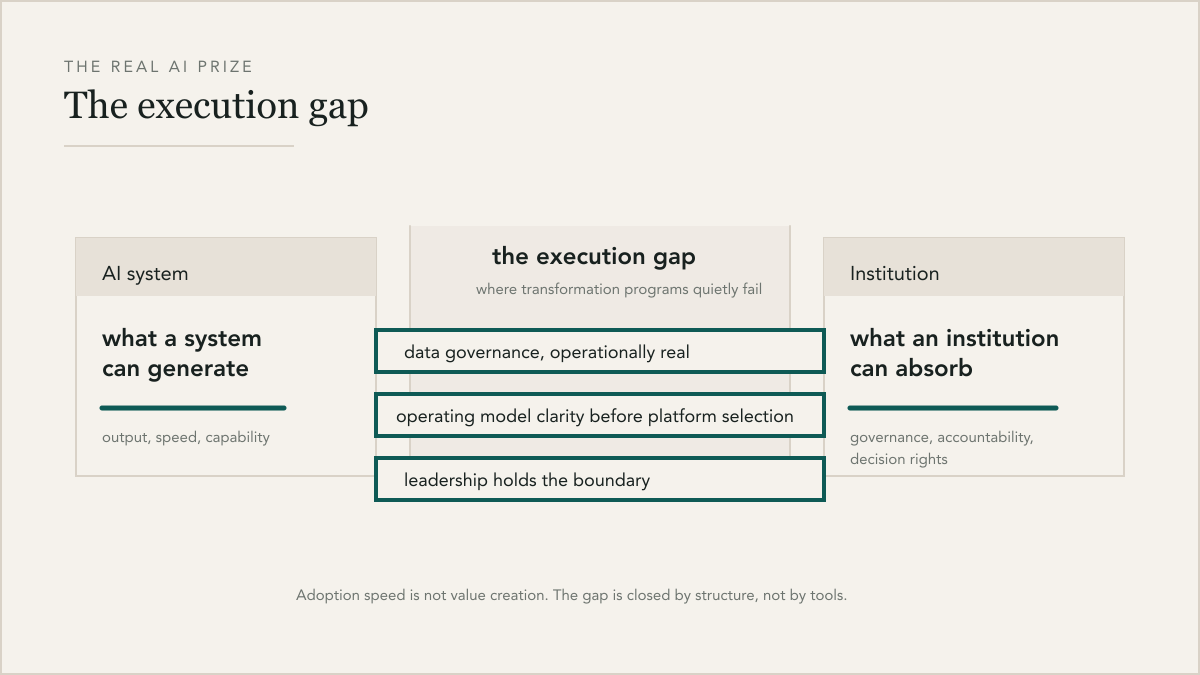
The execution gap, drawn once: closed by structure, not by tools.
The executives who create real value from AI are not the ones who move fastest. They are the ones who know the difference between what AI can generate and what an institution can absorb. That distinction does not appear in any demo. It comes from operating at the boundary between technology and institutional reality. Sometimes the hard way.
That is what this series was about. Not the tools. The judgment required to deploy them well.
This series took that judgment at the altitude of the institution. The same discipline operates at the altitude of the individual: knowing which part of the work is yours to decide, and refusing to hand it to the machine. I wrote that version separately, as a practitioner's guide, Context by Design. If the series is about what an organization has to get right before AI delivers anything durable, the guide is about what you have to get right at your own desk first.
Originally published at omarshraim.com